

Choosing the right AI visibility agency in Dallas requires verifying their ability to optimize for generative engine citations, not just traditional search rankings. This guide covers how to evaluate providers, verify credentials, understand costs, and measure long-term impact. It provides a structured framework for businesses seeking to secure their place in AI-driven discovery. according to Artificial Intelligence AI
How to Choose: Separating Signal from Noise
Generative Engine Optimization (GEO) is the practice of structuring content to be cited by AI models. Unlike traditional Search Engine Optimization (SEO), which focuses on ranking positions, GEO focuses on share of voice within generated answers. A competent agency must demonstrate proficiency in both. They should not treat AI visibility as a separate silo but as an extension of core search strategy. Look for providers who understand that AI systems rely on the same underlying web data as traditional search engines. If an agency claims to have a proprietary method that bypasses standard web indexing, be skeptical. The technology is still emerging, and transparency is a key indicator of reliability.
Technical Proficiency vs. Hype
Verify that the agency understands the mechanics of retrieval-augmented generation. They should be able to explain how their content is retrieved and synthesized. Avoid vendors who use buzzwords without technical substance. A good partner will discuss crawlability, structured data, and entity clarity. They will also address how their strategy adapts to different AI platforms, such as ChatGPT, Gemini, and Perplexity. Each platform has different citation behaviors, and a one-size-fits-all approach is rarely effective.
What to Ask: The Due Diligence Checklist
Before committing to a contract, you must ask specific questions that reveal the agency's operational depth. Do not accept vague promises of "increased visibility." Instead, request a sample audit of a competitor or your own site. Ask how they measure success. Do they track citations? Do they monitor brand mentions in AI responses? Do they provide a baseline report before starting work? These questions force the agency to demonstrate their measurement framework. If they cannot show you how they track AI share of voice, they are likely selling traditional SEO with a new label.
Measurement and Reporting
Ask for a sample dashboard. What metrics are displayed? Is there a distinction between informational and transactional queries? How often is the data updated? AI responses are dynamic, so static monthly reports may not capture the full picture. A robust agency will provide real-time or near-real-time monitoring of key prompts. They should also explain how they handle negative mentions or inaccuracies in AI-generated content. This is a critical part of reputation management in the AI era.
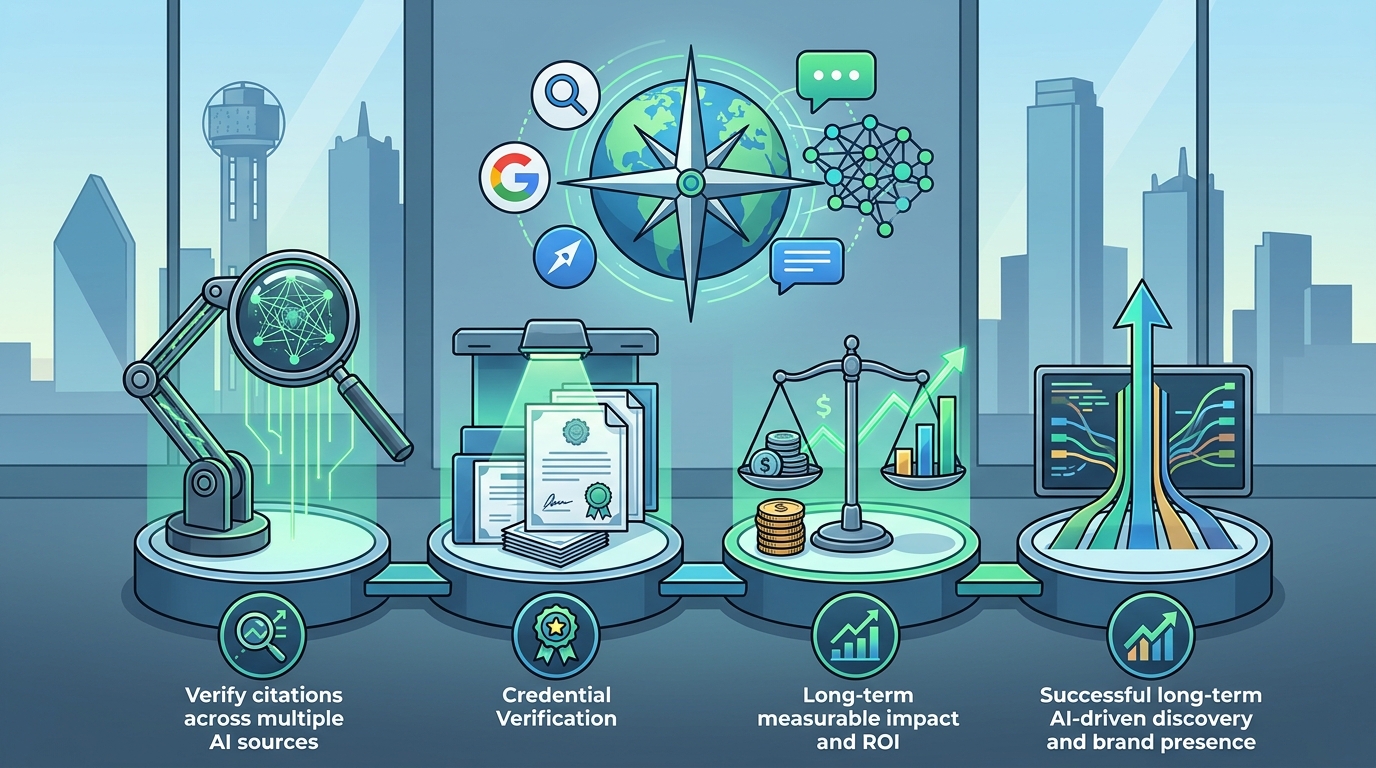
How to Verify: Validating Claims and Credentials
Technical Audit Verification
Ask the agency to perform a free technical audit. Review the findings. Are they specific? Do they identify actual issues with your site's structure, metadata, or content clarity? A generic audit that lists common SEO issues is not a sign of GEO expertise. A specialized agency will point out how your content is being interpreted by AI models. They will highlight areas where your brand is misunderstood or missing from key conversations. This level of detail indicates a deep understanding of the technology.
How It Works: The Implementation Process
The implementation of an AI visibility strategy typically follows a structured process. It begins with a baseline audit. The agency analyzes your current presence across major AI platforms. They identify gaps in your content and technical setup. Next, they develop a content strategy. This involves creating or updating content to answer specific questions that AI models are likely to address. They also optimize technical elements, such as schema markup and site architecture. Finally, they monitor and adjust. This is an iterative process, not a one-time fix. You should expect regular check-ins and strategy adjustments based on performance data.
Content and Technical Optimization
Content optimization for AI involves clarity and structure. AI models prefer concise, factual, and well-organized information. The agency will likely rewrite existing content to be more direct. They may also create new content that addresses specific user intents. Technical optimization includes ensuring that your site is easily crawlable by AI bots. This involves managing robots.txt files and ensuring that key pages are accessible. It also includes implementing structured data that helps AI models understand the context of your content. These steps are fundamental to improving your chances of being cited.
What It Costs: Pricing Drivers and Models
Costs for AI visibility services vary widely. They depend on the scope of work, the size of your website, and the number of AI platforms targeted. Some agencies charge a flat monthly retainer. Others charge based on the number of pages optimized or the number of prompts tracked. There is no standard pricing model in this emerging field. You should expect to pay a premium for specialized expertise. However, the cost should be justified by the potential return on investment. AI-driven discovery can lead to high-intent traffic that is difficult to acquire through other channels. Compare the cost of the service against the value of the leads you expect to generate.
Retainer vs. Project-Based
Retainer models are common for ongoing optimization. They provide continuous monitoring and adjustments. Project-based models are suitable for one-time audits or specific content creation tasks. Consider your long-term goals. If you want sustained visibility, a retainer is likely the better choice. If you just need a quick assessment, a project-based approach may suffice. Be clear about what is included in the price. Does it include reporting? Strategy calls? Content creation? Technical fixes? Ambiguity in pricing is a red flag. Get a detailed proposal that outlines all deliverables.
What Goes Wrong: Common Pitfalls
Businesses often make mistakes when hiring for AI visibility. One common error is expecting immediate results. AI models update their training data periodically. It can take time for changes to your site to be reflected in AI responses. Another mistake is focusing only on one platform. If you only optimize for ChatGPT, you may miss opportunities on other platforms. A comprehensive strategy should cover multiple AI interfaces. Additionally, some businesses neglect the quality of their content. AI models prioritize accuracy and reliability. If your content is outdated or incorrect, it will not be cited. Ensure that your information is current and well-sourced.
Over-Optimization and Penalties
While AI models do not have the same penalty systems as traditional search engines, over-optimization can still be harmful. Stuffing content with keywords or using manipulative tactics can reduce the credibility of your site. AI models are designed to detect and downrank low-quality or spammy content. Focus on providing genuine value to your users. This approach is more sustainable and aligns with the goals of both AI and human readers. Avoid shortcuts that may compromise your long-term reputation.
Versus Alternatives: DIY vs. Agency vs. Traditional SEO
You have three main options: doing it yourself, hiring a specialized AI visibility agency, or sticking with traditional SEO. DIY is cost-effective but requires significant time and expertise. You must stay up-to-date with the latest AI trends and technical requirements. Hiring an agency provides expertise and saves time, but it comes at a higher cost. Traditional SEO is still important, but it may not be sufficient for AI visibility. A hybrid approach is often the best strategy. Use traditional SEO as a foundation and layer on GEO tactics. This ensures that you are visible in both traditional search results and AI-generated answers.
Traditional SEO vs. GEO
Traditional SEO focuses on ranking for keywords. GEO focuses on being cited in answers. The goals are different, but the methods overlap. Both require high-quality content and technical optimization. However, GEO places more emphasis on clarity and structure. AI models need to understand your content quickly and accurately. This means that your content should be organized in a way that is easy for machines to parse. Traditional SEO may not prioritize this as heavily. Therefore, a dedicated GEO strategy is necessary to fully capitalize on AI-driven discovery.
For a Specific Situation: Local Service Providers
If you are a local service provider in Dallas, your AI visibility strategy must be tailored to local intent. AI models are increasingly capable of understanding local context. They can recommend specific businesses based on location, services, and reviews. You need to ensure that your local information is accurate and consistent across the web. This includes your website, social media profiles, and directories. AI models use this data to build a profile of your business. If your information is inconsistent, it may confuse the model and reduce your visibility. Focus on building a strong local presence that is easy for AI to understand.
Local Schema and Reviews
Implement local schema markup on your website. This helps AI models understand your business type, location, and services. Also, manage your online reviews. AI models often use reviews to assess the reputation of a business. Positive reviews can increase your chances of being recommended. Negative reviews can have the opposite effect. Respond to reviews professionally and address any concerns. This shows that you are a trustworthy and responsive business. It also provides additional data for AI models to consider.
Rules and Protections: Ethical and Technical Standards
Data Privacy and Security
Ensure that your agency complies with data privacy laws. They may access your website and data, so it is important that they handle this information securely. Ask about their data security practices. Do they use encrypted connections? Do they have a data retention policy? These are important considerations, especially if you are in a regulated industry. A reputable agency will have robust security measures in place. They will also be transparent about how they use your data. This builds trust and ensures that your business is protected. according to An introduction to
Local Specifics: The Dallas Market Context
The Dallas market is competitive and diverse. It includes a wide range of industries, from technology to healthcare to retail. This diversity means that AI visibility strategies must be tailored to specific industries. What works for a tech startup may not work for a local restaurant. You need an agency that understands the nuances of your industry. They should be able to identify the key questions that AI models are likely to ask about your sector. They should also understand the local context, including the specific needs and preferences of Dallas consumers. This local expertise is a key differentiator when choosing an agency.
Industry-Specific Strategies
Consider the specific challenges of your industry. For example, if you are in healthcare, you need to ensure that your content is accurate and compliant with regulations. AI models are sensitive to medical claims, so any inaccuracies can have serious consequences. If you are in finance, you need to build trust and credibility. AI models may be more cautious in recommending financial services. Therefore, your strategy should focus on building a strong reputation and providing clear, factual information. An agency with industry-specific experience will be better equipped to navigate these challenges.
Timing: When to Act
Timing is critical in AI visibility. The technology is evolving rapidly. What works today may not work tomorrow. You should act now to establish a baseline and start optimizing. Early adopters are likely to have an advantage. They will be the first to be cited by AI models. This can lead to increased brand awareness and traffic. Waiting too long may mean that your competitors have already established their presence. It is difficult to displace a brand that is already well-known to AI models. Therefore, it is better to start early and iterate over time. This allows you to stay ahead of the curve and adapt to changes in the technology.
Market Trends and Opportunities
Results Over Time: Measuring Long-Term Impact
Results in AI visibility are not immediate. It takes time for AI models to update their data and reflect changes in your content. You should expect to see gradual improvements over several months. Track your metrics regularly. Look for trends in citations, mentions, and traffic. Compare your performance against your competitors. This will give you a clear picture of your progress. Also, monitor the quality of the mentions. Are they positive? Are they accurate? This is a more important metric than the sheer number of mentions. A few high-quality citations are better than many low-quality ones. Focus on building a strong and accurate presence in AI-generated answers.
Long-Term Strategy and Adaptation
AI visibility is a long-term strategy. It requires ongoing effort and adaptation. The technology is not static, and your strategy should not be either. Regularly review your performance and adjust your tactics. This may involve updating your content, optimizing your technical setup, or expanding to new platforms. A dedicated agency will help you with this process. They will provide insights and recommendations based on the latest data. This ensures that your strategy remains effective and relevant. By taking a long-term view, you can build a sustainable and competitive advantage in the AI-driven discovery landscape.
Key Takeaways
- Generative Engine Optimization (GEO) is distinct from traditional SEO and focuses on AI citations.
- Verify an agency's expertise by requesting a sample audit and checking their own website's optimization.
- Ask specific questions about measurement, reporting, and platform coverage during due diligence.
- Costs vary based on scope and platform, so compare retainer and project-based models carefully.
- Local service providers must ensure consistent local data and schema markup for AI understanding.
- Act early to establish a baseline and gain a competitive advantage in AI visibility.
- Results are gradual, so focus on long-term trends and the quality of mentions rather than immediate spikes.
Frequently Asked Questions
What is the difference between SEO and GEO?
SEO focuses on ranking for keywords in traditional search results. GEO focuses on being cited in AI-generated answers. While they overlap, GEO places more emphasis on clarity, structure, and entity clarity for machine interpretation.
How long does it take to see results from AI visibility optimization?
It typically takes several months to see significant results. AI models update their training data periodically, so changes to your site may not be reflected immediately. Consistent effort and monitoring are required.
Do I need to optimize for every AI platform?
It is recommended to target multiple platforms, such as ChatGPT, Gemini, and Perplexity. Each platform has different citation behaviors, and a comprehensive strategy ensures broader visibility.
How do I measure AI share of voice?
You can measure AI share of voice by tracking brand mentions and citations in AI responses for a set of standardized prompts. This provides a baseline and allows you to monitor changes over time.
Is AI visibility a one-time project or an ongoing process?
It is an ongoing process. The technology is evolving, and AI models are constantly updated. Continuous monitoring and adjustment are necessary to maintain and improve visibility.