

Choosing the right Generative Engine Optimization (GEO) consultant requires evaluating their ability to measure AI share of voice, not just traditional search rankings. The best partners focus on how brands are cited, recommended, and understood within conversational AI interfaces like ChatGPT. This guide covers how to evaluate, verify, and select a GEO consultant to improve your visibility in AI search. according to GEO Generative Engine
How to Choose a GEO Consultant
Generative Engine Optimization is the practice of improving how a business and its information can be discovered, understood, and represented in generated answers. It differs from traditional SEO because it focuses on inclusion within synthesized answers rather than just ranking on a results page. A good consultant understands that AI visibility is contextual, not a single permanent ranking.
Focus on Conversational Intent
Look for partners who understand that customer intent has shifted from keywords to conversations. Instead of optimizing for a single phrase, they should analyze the context, preferences, budget, and geography of the user's question. If a consultant only talks about backlinks and keyword density, they are likely applying outdated SEO tactics to a new problem.
Measurement Frameworks
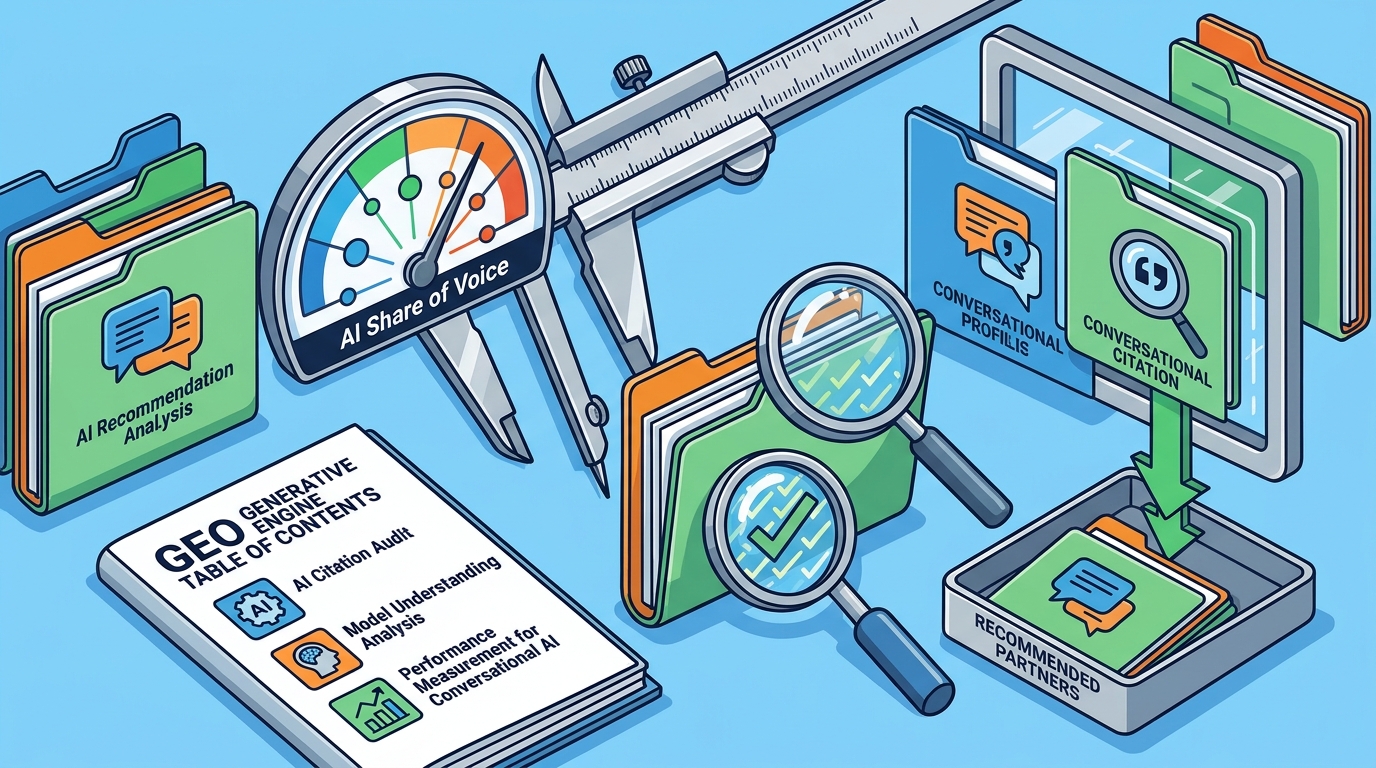
The best consultants use a standardized prompt set to measure AI Share of Voice. They should be able to demonstrate how they track brand mentions, citations, and recommendation context across different AI platforms. Avoid providers who cannot show you a baseline measurement before they begin work.
What to Ask Before Committing
Before hiring a GEO consultant, you need to ask specific questions that reveal their methodology. These questions help distinguish between those who understand the mechanics of AI search and those who are simply rebranding old SEO services.
Methodology Questions
Ask how they determine which sources an AI model relies on for specific question types. Inquire about their approach to first-party versus third-party source corroboration. A strong consultant will explain how they build an information environment that is both clear and credible to the model.
Reporting Questions
Ask what metrics they report and how often. You should expect to see data on mention rates, citation rates, and commercial share of voice. Ask if they distinguish between informational prompts and transactional prompts in their reporting.
How to Verify Claims and Credentials
There is no public master list of websites that AI platforms universally trust. Therefore, you must verify a consultant's claims by looking at their own visibility. If a consultant claims to be an expert in GEO, check if they are cited in AI answers for relevant topics. This is a practical way to test their expertise.
Check Their Own AI Visibility
Run a series of prompts related to their services in ChatGPT or other AI tools. See if their name or website is mentioned. If they are not visible in the very space they claim to optimize, their credibility is questionable. This is a direct test of their capability.
Review Case Studies
Ask for case studies that show before and after metrics. Look for evidence of improved citation rates or increased referral traffic from AI platforms. Be skeptical of vague claims without data. A legitimate consultant will be transparent about their methodology and results.
How the Process Works
The GEO process typically follows a structured workflow. It begins with a baseline audit, moves to content and technical optimization, and ends with ongoing monitoring. Understanding this sequence helps you set realistic expectations for the engagement.
Phase 1: Baseline Audit
The consultant builds a prompt universe based on your customer's buying journey. They run these prompts to establish a Day 0 baseline. This includes recording whether your brand appears, which competitors are mentioned, and what external sources are cited. This step is critical for measuring future progress.
Phase 2: Optimization
Based on the audit, the consultant works on improving your first-party sources. This involves making your website the clearest source of truth about your company. They may also work on building third-party corroboration through reputable publications, directories, and expert interviews. The goal is to create a coherent presence across relevant sources.
Phase 3: Monitoring
After optimization, the consultant continues to monitor your AI visibility. They track changes in mention rates and citation patterns over time. This ongoing monitoring allows them to adjust the strategy as AI models and user behavior evolve.
What It Costs
The cost of GEO services varies based on the scope of the engagement and the complexity of the industry. There is no standard price list, but several factors drive the price up or down. Understanding these factors helps you budget appropriately.
Scope of Services
A basic audit is less expensive than a full-service engagement that includes content creation, technical fixes, and ongoing monitoring. The number of platforms tracked (e.g., ChatGPT, Gemini, Perplexity) also affects the cost. More platforms mean more data to collect and analyze.
Industry Complexity
Industries with high regulatory requirements or complex buying cycles may require more detailed optimization. For example, a cybersecurity company needs to address different prompts than a local restaurant. The depth of the prompt universe and the level of third-party corroboration needed will influence the final price.
Common Mistakes to Avoid
Many businesses make mistakes when adopting GEO strategies. These errors can waste time and money, and they may even harm your brand's reputation. Being aware of these pitfalls helps you avoid them.
Ignoring Technical Accessibility
A site that is technically broken or impossible to crawl will not thrive in AI search. Ensure your website is accessible and structured properly before expecting AI visibility. Technical SEO remains a foundation for GEO.
Chasing Vanity Metrics
Do not focus solely on total mention count. A brand that appears in low-value educational prompts may have less commercial value than one that appears in fewer but more transactional prompts. Always weight your metrics by intent.
GEO vs. Traditional SEO
Generative Engine Optimization and traditional SEO overlap, but they are not the same. SEO optimizes for results pages, while GEO optimizes for answers. Understanding the differences helps you allocate resources effectively.
| Feature | Traditional SEO | GEO |
|---|---|---|
| Primary Goal | Rank on search results pages | Be cited in generated answers |
| User Intent | Keyword-based | Conversational and contextual |
| Measurement | Rank position and click-through rate | Mention rate and share of voice |
| Content Focus | Keyword density and backlinks | Clarity, credibility, and corroboration |
SEO is not dead. It remains a critical component of digital marketing. However, GEO adds a new layer of strategy that focuses on how AI systems interpret and recommend your brand.
GEO for Specific Business Situations
The approach to GEO changes depending on your specific business situation. Different industries and business models require different strategies to achieve visibility in AI search.
B2B vs. B2C
B2B companies often face longer buying cycles and more complex decision-making. Their GEO strategy should focus on building authority through thought leadership and expert interviews. B2C companies may focus more on local relevance and product comparisons.
Local vs. National
Local businesses need to ensure their geographic context is clear to AI models. This includes optimizing for location-specific prompts and ensuring consistent information across local directories. National brands may focus on broader category authority.
Rules and Ethical Protections
There are no specific legal rules governing GEO, but ethical guidelines are important. Consultants should not use deceptive practices to manipulate AI models. Transparency and honesty are key to building long-term trust.
Transparency in Reporting
Consultants should be transparent about their methods and limitations. They should not promise guaranteed rankings or citations, as AI models are not deterministic. They should clearly communicate what they can and cannot control.
Data Privacy
Ensure that any data collected during the GEO process is handled in compliance with privacy regulations. This includes protecting customer data and ensuring that any third-party sources used are reputable and compliant.
Local and Regional Considerations
AI search can be influenced by location and regional context. For local businesses, this means optimizing for geographic relevance. For national or global brands, it means understanding how different regions may interpret the same prompt differently.
Geographic Context
AI platforms may use location data to tailor answers. Ensure your website clearly states your service area. This helps AI models understand where you operate and who you serve. Local businesses should also monitor their visibility in location-specific prompts.
Regional Variations
Different regions may have different search behaviors and preferences. A prompt that works well in one region may not perform as well in another. Monitor your AI visibility across different regions to identify any gaps or opportunities.
Timing Your GEO Strategy
Timing is critical when adopting a GEO strategy. The AI search landscape is evolving rapidly, and early adopters may have a significant advantage. Waiting too long can result in falling behind competitors who are already visible in AI answers.
Early Adoption
Starting your GEO strategy now allows you to build a baseline and establish your presence before the market becomes saturated. Early adopters can also learn from their experiences and adjust their strategies as the technology evolves.
Continuous Adaptation
GEO is not a one-time project. It requires continuous adaptation as AI models and user behavior change. Regularly review your strategy and adjust your approach based on new data and insights.
Measuring Results Over Time
Measuring the results of your GEO strategy is essential for understanding its impact. By tracking key metrics over time, you can determine what is working and what needs adjustment. This data-driven approach ensures that your investment in GEO is delivering value.
Key Metrics to Track
Track your brand mention rate, citation rate, and commercial share of voice. Compare these metrics against your baseline to measure progress. Also monitor any changes in referral traffic from AI platforms. These metrics provide a comprehensive view of your AI visibility.
Long-Term Trends
Look for long-term trends in your AI visibility. Are your mention rates increasing? Are you being cited more frequently? Are you appearing in more high-value prompts? These trends indicate whether your GEO strategy is effective in the long term.
Key Takeaways
- Generative Engine Optimization is the practice of improving how a business is discovered and represented in generated answers.
- Choose a consultant who focuses on conversational intent and uses standardized prompt sets for measurement.
- Verify a consultant's expertise by checking their own AI visibility and reviewing their case studies.
- The GEO process involves a baseline audit, optimization, and ongoing monitoring.
- Costs vary based on the scope of services and industry complexity.
- Avoid common mistakes like ignoring technical accessibility and chasing vanity metrics.
- GEO differs from traditional SEO in its focus on answers rather than results pages.
- Timing is critical, and early adoption can provide a significant advantage.
Frequently Asked Questions
What is the difference between GEO and AEO?
Generative Engine Optimization (GEO) focuses on improving visibility in generated answers, while Answer Engine Optimization (AEO) focuses on making information useful for direct answers to specific questions. In practice, their methods often overlap.
How long does it take to see results from GEO?
Results can vary, but it typically takes several weeks to months to see significant improvements in AI visibility. This depends on the complexity of your industry and the current state of your online presence.
Do I still need traditional SEO if I am doing GEO?
Yes, traditional SEO remains a foundation for GEO. A site that is technically broken or impossible to crawl will not thrive in AI search. SEO and GEO are complementary, not mutually exclusive.
How do I measure AI Share of Voice?
AI Share of Voice is measured by tracking brand mentions, citations, and recommendations across a standardized set of prompts. This provides a more accurate picture of your visibility than traditional rank tracking.
Can I do GEO myself?
You can start by optimizing your website for clarity and credibility. However, working with a consultant can provide expertise in measurement and strategy that is difficult to replicate on your own.
What are the risks of not doing GEO?
If you do not optimize for AI search, you may become invisible in the conversations that lead to customers. Competitors who are visible in AI answers may capture the attention and trust of your potential customers.
Conclusion
Choosing the right GEO consultant is a critical decision for any business looking to improve its visibility in AI search. By focusing on conversational intent, using standardized measurement frameworks, and verifying credentials, you can find a partner who will help you succeed in this new discovery environment. Contact Jeet Banerjee to discuss how you can improve your AI visibility and stay ahead of the curve.